 comparison
Which Florida Mortgage Lenders Are Most Transparent in 2026?
Last Updated: November 6, 2026
Quick Summary
Transparent mortgage lenders disclose the full cost of a loan early and in writing, explain each Loan Estimate figure, and keep communicating through underwriting. Compare them by scoring fee disclosure, rate-lock terms, and Loan Estimate consistency.
- Score each lender from 1 to 5 on fee disclosure, rate-lock terms, and Loan Estimate consistency.
- Weight fee disclosure and Loan Estimate consistency most heavily, since they affect cash due at closing.
- Request Loan Estimates from at least three lenders on the same day for a fair comparison.
- Compare the interest rate and APR together, because a lower rate can carry higher upfront points.
- Ask every lender in writing whether it is a direct lender or broker and how it is paid.
Table of Contents
- What Transparency Means in a Mortgage Lending Process
- Mortgage Lender Fees and Closing Costs in Florida
- How to Read a Loan Estimate Line by Line
- How to Compare Mortgage Rates Fairly
- Broker Versus Direct Lender: Who Gets Paid and How
- Transparency From Application Through Closing
- Questions to Ask Before You Choose Your Lender
- Frequently Asked Questions
Florida homebuyers often feel most uncertain at the point where a loan is supposed to become clear. The Loan Estimate is meant to show your rate, fees and cash due, yet many borrowers still get surprised at closing. Jr Mortgage works with buyers and investors across Broward, Miami-Dade and Palm Beach counties, and we believe a transparent lending process matters. This guide explains what transparency looks like, what to check in a lender, and how to protect yourself before you sign.
What Transparency Means in a Mortgage Lending Process
Most lender lists tell you a company is "transparent" and move on. That is a marketing claim, not a measurement. A useful definition has to be observable, comparable across lenders, and tied to documents you actually receive. The working definition here: a transparent lender discloses the real cost of a loan early and in writing, explains each figure before you commit, and keeps explaining as the loan moves through underwriting.
A five-criteria transparency score you can apply yourself
Score each lender from 1 to 5 on the criteria below, using only what you can document. A lender that scores well on all five is behaving transparently regardless of how it advertises.
- Fee disclosure completeness. Does the Loan Estimate itemize every lender fee in Section A and identify which third-party costs in Sections B and C the lender does not control? A complete disclosure names each charge; an incomplete one bundles fees into a single "origination" line.
- Rate-lock terms in writing. Is the lock period, the cost to extend it, and what happens if closing slips stated on paper before you lock? Vague verbal assurances ("we'll take care of you") score low.
- Loan Estimate consistency. When you compare the initial Loan Estimate to the Closing Disclosure, do the lender-controlled fees stay within the tolerance limits federal rules set, or do they drift upward? Repeated increases in Section A are a measurable red flag.
- Communication cadence. Does the lender commit to a named contact and a stated update frequency (for example, weekly status updates during processing and underwriting), and does it actually hit that cadence?
- Explanation of underwriting decisions. When a condition or denial appears, does the lender explain the specific reason and what would cure it, or does it send a generic notice?
Why a score beats a vibe
A borrower comparing three lenders can fill in this grid in an afternoon using documents already in hand. The lender with the highest score is not automatically the cheapest, but it is the one least likely to surprise you at closing.
Watch out: a lender can score well on communication and still fail on fee disclosure. Weight criteria 1 and 3 most heavily, because those are the ones that move your cash to close.
Mortgage Lender Fees and Closing Costs in Florida
Closing costs are the fees you pay to finish the loan, and they are the most common source of closing-table surprise. Our guide on how to avoid hidden mortgage closing costs in Florida shows you what to look for before you sign. Lender fees, origination charges, underwriting, processing, and sometimes a separate application or rate-lock fee, sit alongside third-party costs such as appraisal, title insurance, recording fees, and prepaid taxes and insurance. The lender controls Section A; it does not control most of Sections B and C, which is exactly why a transparent lender separates them clearly.
The state-specific line items borrowers overlook
Florida closing documents can include state-specific charges that borrowers often misread: ways to cut FHA closing costs in Florida covers practical steps to reduce them.
How insurance, flood zones, and condos move the estimate
Homeowners insurance and flood coverage can add to the monthly payment and are generally outside the lender's control. A property in a designated flood zone may require flood insurance, and a condominium purchase may involve association review that can affect timing or loan terms. Property taxes are another variable: the tax figure on the Loan Estimate is an estimate, and a reassessment after purchase can raise the escrow payment.
A transparent lender flags these early, ideally at preapproval, not at closing, and tells you which figures are estimates that can change and which are fixed.
How to compare fees without being misled
Do not compare the "Total Closing Costs" line alone. Compare Section A across lenders for the same loan scenario, then compare the annual percentage rate, which folds in many fees and gives a broader cost view. Ask each lender to identify, in writing, which fees are lender-controlled and subject to tolerance limits and which are third-party estimates. That single question separates a lender that is explaining the estimate from one that is merely quoting it.
Watch out: a low advertised rate paired with high discount points can produce a higher APR than a slightly higher rate with no points. Compare rate and points together, not the rate in isolation.
Closing costs split into lender fees and third-party charges, and the cost categories below show which party controls each line.
| Cost category | Who controls it | Where it appears |
|---|---|---|
| Origination, underwriting, processing | Lender | Section A |
| Services you cannot shop for | Third parties | Section B |
| Services you can shop for | Third parties | Section C |
| Property taxes and insurance (escrow) | Estimates, can change | Prepaid items |
How to Read a Loan Estimate Line by Line
The Loan Estimate is a standard form provided under federal rules (TILA-RESPA integrated disclosures (TRID)). It is the best tool you have for comparing lenders because every lender uses the same layout.
Start with page one. Check the loan amount, interest rate, monthly principal and interest payment, and whether the rate can change. Then review the projected payments and the "Cash to Close" figure.
Next, examine Section A (origination charges), Section B (services you cannot shop for) and Section C (services you can shop for). Section A is where lender fees appear. Compare these lines across lenders, because they show what each company charges for the same work.
Finally, check the "Total Closing Costs" figure and the comparison table, which shows how much the loan costs over time. Compare these numbers, not just the monthly payment.
How to Compare Mortgage Rates Fairly
A lower advertised rate can cost more once fees are included. Fair comparison means matching the same loan type, loan amount, down payment, credit profile and lock period across every quote.
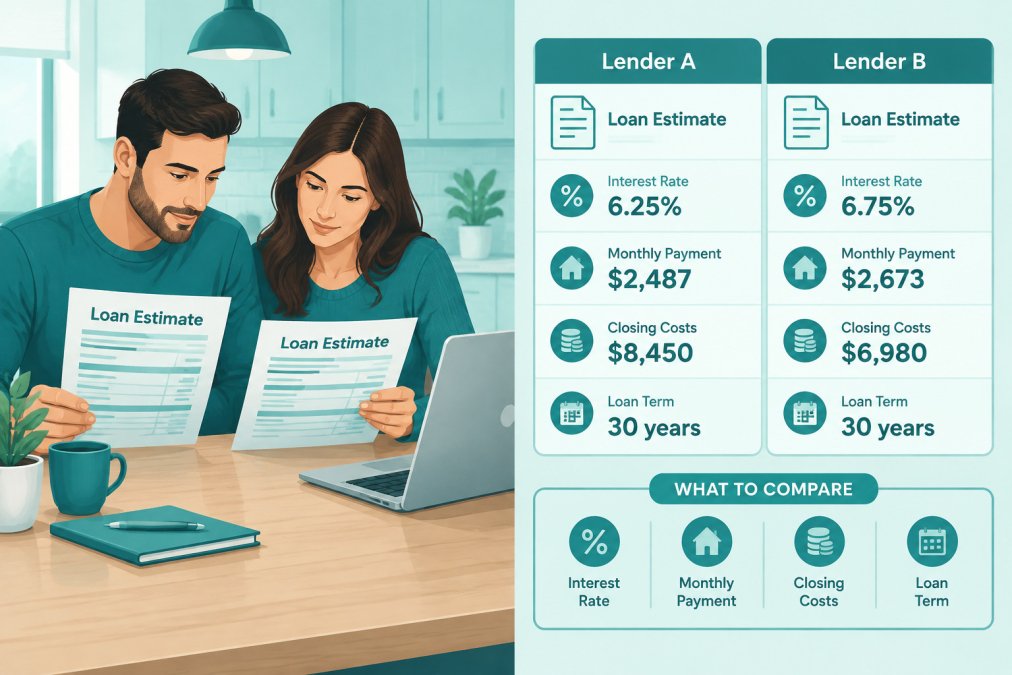
Request Loan Estimates from at least three lenders on the same day. Compare the interest rate and the annual percentage rate together, since the APR includes many fees and gives a broader view of cost. Then compare the lender credits or points each company offers, because a lower rate often comes with upfront points.
Rate quotes change daily, so note the date and time of each quote. Ask how long the rate is locked and what it costs to extend the lock if closing is delayed.
Broker Versus Direct Lender: Who Gets Paid and How
A direct lender funds your loan from its own resources and earns money from the rate and fees it charges. A mortgage broker works with multiple wholesale lenders and earns compensation from the lender, from you, or from both, depending on how the loan is structured.
Neither model is automatically better. Brokers can offer access to more loan products, but their compensation can create incentives to steer you toward a higher-cost option. Direct lenders can offer simplified processing, but they only show their own programs.
Ask any broker or lender how they are paid, whether they receive a yield spread premium or other lender compensation, and how that payment affects your rate. Request this in writing. If you are weighing a broker, our guide on how to pick a South Florida mortgage broker as a first-time buyer explains what to check.
Transparency From Application Through Closing
Transparency should continue after you sign the application. Good lenders keep you informed at each stage: application, processing, underwriting, appraisal, clear to close and funding.
Ask for a timeline with clear milestones and a named contact. If you are still narrowing your list, see which best mortgage lenders in Palm Beach County are rated highest. Confirm how often you will receive updates and how documents should be submitted. A lender who responds to questions quickly during the application usually continues that pattern through closing.
Before closing, you receive the Closing Disclosure at least three business days in advance (TILA-RESPA Integrated Disclosure FAQs). Compare it line by line with your Loan Estimate. Any changes to certain fees are restricted, and the form will show where costs have increased (Can my final mortgage costs increase from what was on my Loan Estimate?). If something does not match, raise it before you sign.
Questions to Ask Before You Choose Your Lender
Use these questions to test transparency early:
- What is my estimated cash to close, and which costs could change?
- Are you a direct lender or a broker, and how are you compensated?
- Can you provide a written Loan Estimate for my specific scenario?
- How long is the rate lock, and what does an extension cost?
- How long does your process usually take from application to closing?
- Who will be my main point of contact, and how fast do you respond?
A lender who answers these clearly and in writing is showing you the kind of transparency that protects you. For a step-by-step framework, read how to choose a mortgage lender for your first home. At Jr Mortgage, we aim to walk borrowers through each figure clearly. If you want a clear, personalized review of your options, apply for a loan now and we will show you exactly what your costs will look like before you commit.
Frequently Asked Questions
Which mortgage lenders are most transparent about fees and rates?
No single lender wins on every measure, so the most transparent choice is the one that gives you a written Loan Estimate quickly, explains each fee without pressure, and matches its quoted rate to a locked rate in writing. Request Loan Estimates from at least three lenders on the same day, using the same loan amount, down payment, and credit profile. Compare the origination charges, third-party fees, and cash to close lines. A lender that answers your questions directly and puts every cost in writing is showing the transparency you are looking for.
What fees should a mortgage lender disclose?
Under federal rules, a lender provides a Loan Estimate after receiving your application, and it itemizes fees in standard categories. Ask about any fee that is not on the form, including processing, underwriting, and document preparation charges. Ask whether a fee is paid to the lender, to a third party, or to a broker.
When should I receive a Loan Estimate?
You should receive a Loan Estimate after a lender receives your application, as required under federal TILA-RESPA rules; confirm current timing with the Consumer Financial Protection Bureau. If you have not received one, ask the lender for it in writing. Keep a record of when you applied and when you received the form.
What questions should I ask a mortgage lender before applying?
Ask for a written breakdown of all fees, whether the rate you are quoted is locked and for how long, and whether the lender pays a broker or a third party for your loan. Ask how long the company typically takes from application to closing and who will be your point of contact. Ask whether the loan is sold after closing and who will service it. Ask what documents you will need and whether your income type, such as self-employment or investment rental income, fits the programs offered. Clear, direct answers usually signal a transparent process.